
LC Phone Alternative for HighLevel Teams
LC Phone alternative 7 min read
Comparing an LC Phone alternative for GoHighLevel: what LC Phone covers, where Phone Clover's Telnyx-based billing differs, and a decision checklist.
- Best for
- Teams that want visibility into carrier costs and number health, want to keep an existing number without porting, or need numbers LC Phone does not carry.
- Not for
- Workflows that depend on in-order call routing, warm transfer, three-way calling, or E911 emergency addressing.
- The difference
- Phone Clover charges its own software fee and passes Telnyx usage through with no markup, versus LC Phone's flat 5% markup on carrier and compliance fees.
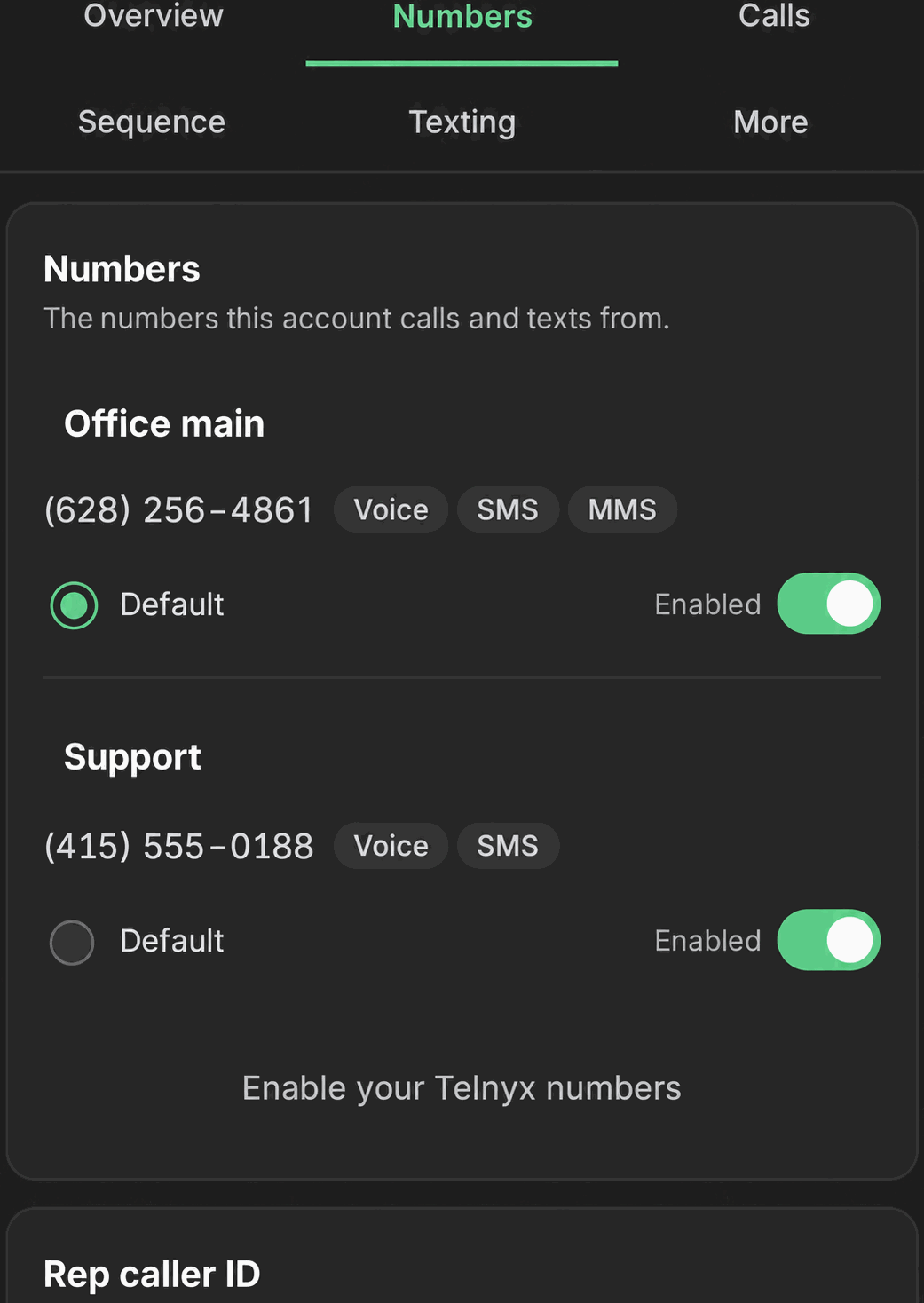
If you’re looking at an LC Phone alternative, you’re probably running into one of a short list of problems: a spam-flagged number, a text that silently failed, a rate you can’t inspect, or an international number GHL simply doesn’t sell. This article lays out what LC Phone actually is, where a Telnyx-backed option like Phone Clover genuinely differs, and where it doesn’t, so you can make the call with real numbers instead of a vendor’s headline claim.
What LC Phone covers
LC Phone is GoHighLevel’s built-in, default phone option. It isn’t a separate product you shop
for; it’s the phone tab that’s already there when a sub-account is created. Under the hood, it’s a
white-labeled Twilio account: the SIP domain for VoIP desk phones is literally
<LocationName>.sip.ashburn.twilio.com.
It handles the basics reps expect: calling, texting, recording (with AI transcription as a paid add-on), a ring-group style inbound setup, and voicemail with a greeting. It also runs entirely inside GHL’s own account structure, which means no separate carrier login and no separate compliance flow to think about.
Why teams compare carrier options
Two recurring complaints drive most LC Phone searches. First, carrier-level opacity: a text fails with a generic error, or a number starts getting flagged as spam, and there’s no way to see the underlying number-health data to understand why. Second, cost and control at the voice layer: LC Phone bills $0.0166/min outbound and $0.01165/min inbound, plus a flat 5% markup on carrier, A2P, and verified-caller-ID fees regardless of rebilling settings.
There’s also a documented gap in the power-dialer category. Answering-machine detection for the power dialer is one of the most widely requested unshipped features on GHL’s own ideas board, which tells you a fair number of teams have already outgrown what’s built in.
How Phone Clover bills usage
Phone Clover doesn’t bundle a carrier markup into a flat per-seat price the way most competitors do. You connect your own Telnyx account and pay Telnyx directly for numbers, minutes, and SMS segments, with no markup. The software fee is separate (Texting, Pro, Agency Growth or Agency Scale, all early-access pricing right now). That means you can see what you’re actually paying for carrier usage instead of a number baked into a bundle.
Note: SMS rates between Telnyx and Twilio (LC Phone’s carrier) are close. The real, defensible price gap is in voice and international numbers, not a blanket “cheaper texting” claim. Don’t expect SMS costs to change dramatically just from switching.
SMS, calling, reporting, and number health differences
SMS provider control. Phone Clover can register as the sub-account’s native SMS provider, so Conversations, workflow Send SMS steps, and bulk SMS all route through your Telnyx numbers. You can also add texting to a number you already use for calls elsewhere, without porting it. See Text-enable an existing number without porting.
Calling. Both are desktop browser experiences layered outside GHL’s native call surface, a constraint GHL’s own developer docs impose on every phone app, not a Phone Clover limitation. Phone Clover adds a caller card before pickup (name, tags, DND, latest note, and pipeline stage once granted), a required post-call outcome with custom tags and follow-up tasks, and calling lists built from a tag or from selected contacts, with DND and calling-hours checks re-run at dial time.
Reporting. Phone Clover’s dashboard shows Today/7-day/30-day stat tiles, a filterable call log, per-rep stats for admins, and a CSV export capped at 1,000 rows. It doesn’t yet chart activity over time, so if trend charts matter to your reporting, that’s a real gap today.
Number health. This is where the two differ the most. Phone Clover surfaces per-number delivered and spam-ratio trends, CNAM status, and STIR/SHAKEN signing, with an optional auto-rotate that moves texting to a healthier number when one gets flagged. LC Phone’s own documentation states plainly that STIR/SHAKEN and CNAM registration “do not remove nuisance or spam labels” on outbound calls, and remediation there is manual. Neither product removes spam labels broadly; the difference is whether you can see the problem forming before a rep notices calls going unanswered. That visibility is the actual product, not a promise that flagged numbers stop being flagged.
See See per-number delivery and spam trends and Register for A2P 10DLC for the compliance side of texting on either carrier.
Decision checklist
Ask these before switching:
- Do you need in-order call routing, warm transfer, or three-way calling? None of these are built in Phone Clover today. If any is a hard requirement, stay on LC Phone or evaluate another vendor.
- Do you need E911 / emergency address support? Not provisioned on any Phone Clover number as of this writing. Don’t move a sub-account’s primary line without confirming this doesn’t matter for your use case.
- Is voice cost or international coverage your main pain point? This is where Phone Clover has the clearest edge: about $0.007/min outbound at Telnyx list price versus LC Phone’s $0.0166/min. At typical volumes the $79 Pro subscription outweighs the savings, so this matters most for heavy callers.
- Do you need to text from a number you already use for calls, without porting? Hosted SMS covers US landline and VoIP numbers for this. Mobile numbers can’t be hosted this way on either platform.
- Does your team need charts over time in reporting? Not built yet. Today/7/30-day tiles and a filterable log exist; trend charts don’t.
The shared constraint nobody’s marketing mentions
Worth repeating clearly: no third-party phone app, including Phone Clover, can place or receive calls inside GHL’s own native call surface. GHL’s developer documentation states this outright: call providers can only log calls via inbound and outbound APIs, not run inside the CRM’s built-in dialer. That’s why every competitor in this space, ours included, builds a widget, an iframe, or an extension instead of extending the native call button. If a sales rep tells you their product runs “natively inside GHL’s own calling,” ask what that actually means in practice, because the platform itself doesn’t allow it yet.
Migration path if you decide to switch
Moving off LC Phone doesn’t have to be an all-or-nothing cutover. A reasonable sequence: adopt or buy your first Telnyx number and confirm calling works from the browser softphone, run it alongside LC Phone for a week or two on a secondary number, then decide whether to register Telnyx as the sub-account’s native SMS provider. If your primary business number is a landline or VoIP number you don’t want to port, hosted SMS lets you add texting to it without touching how LC Phone (or another provider) handles the calls on that same number in the meantime. There’s no requirement to migrate voice and SMS on the same day, or even the same week.
What “alternative” doesn’t mean here
It’s worth being clear about scope. Phone Clover doesn’t replace HighLevel, and it doesn’t remove LC Phone from your sub-account automatically. Switching means routing calling and texting for a number through Telnyx instead of Twilio, using Phone Clover’s UI instead of the native Phone tab. Your contacts, pipelines, and automations stay exactly where they are; only the phone and SMS layer changes hands. Treat the migration steps in this article as a starting point to test against your own setup rather than an all-or-nothing switch you have to complete in a single sitting.
What to check before you commit a whole sub-account
Before switching a sub-account off LC Phone entirely, verify a short list of things against your own setup rather than taking either vendor’s word for it: confirm your state isn’t Hawaii or Alaska if you plan to rely on the calling-hours fallback window, confirm any number you want text-enabled is a US landline or VoIP number (not mobile) if you’re avoiding a port, and confirm whether your team’s reporting needs include trend charts, since neither Today/7/30-day tiles nor a filterable log replace an actual chart over time. None of these are dealbreakers on their own, but each one changes how much setup work you should expect before go-live.
When Phone Clover fits, and when it doesn’t
Phone Clover is a reasonable LC Phone alternative for teams that want visibility into carrier costs and number health, want to keep an existing business number without porting it, or need international numbers LC Phone doesn’t carry. It’s a weaker fit if your workflow depends on in-order routing, warm transfer, three-way calling, or E911, since none of those exist in either product built by us today. If those are hard requirements, LC Phone (or a vendor that ships them) is the more honest recommendation right now.
Compare the two side by side at /compare/lc-phone, see current pricing at /pricing, and read the number health feature page at /product/number-health. Whichever way you go, treat any specific percentage or dollar-savings claim, from us or anyone else, as a starting estimate to check against your own call and text volume, not a guarantee.